
The AI K-Shape
The Productivity Gap Among Employees Is Becoming Permanent

The shape you should be thinking about
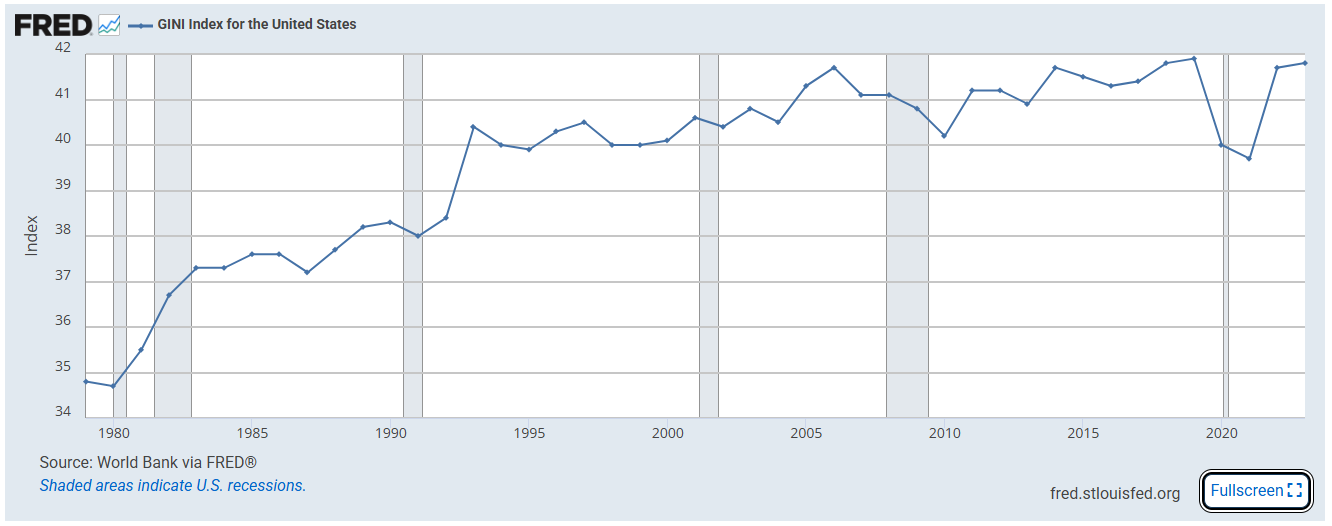
You’ve probably heard of the “K-shaped recovery”, the term economists use to describe what happened after COVID. Asset owners and upper-middle-class people rode the top of the K as equities, housing, and other assets inflated. Everyone else rode the bottom as inflation ate their purchasing power. The Gini coefficient - the economist’s measure of inequality - hit new highs, continuing a decades-long trend.
A new K is forming. It’s about who uses AI at work and who doesn’t.
It’s rarer than you think
Living in SF, LA, NYC, or Austin makes you assume that AI in the workplace is table stakes. It isn’t. Walk into most government offices, large corporations, or small businesses and you’ll find salespeople manually logging notes, analysts manually compiling reports, or accountants grinding through Excel by hand. Then walk down the street into a startup and you’ll find employees directing agents to do most of that same work for them.
This dichotomy isn’t just about speed to complete tasks, more importantly it’s about total output per person. And for most companies outside of manufacturing and industrial sectors, employee costs dominate. So the question becomes: how does a company staffed with non-AI-enabled workers compete when the average AI-enabled knowledge worker is 2-10x more productive?
My answer is that most of them won’t compete. My theory is that the firms that survive fall into two buckets:
Momentum: brand recognition, long-term contracts, repeat buying habits, price-insensitive customers (governments being the most obvious). These companies can coast for a while on their existing flywheel.
Regulatory capture: heavily regulated industries like electricity create captive monopolies where competitive pressure is stifled regardless of productivity gaps.
As it goes for the firms that fit these two categories, so will it go for the employees working within them. I predict that knowledge workers at companies fitting either or both of the above-two criteria will largely go between each other’s firms rather than join startups or businesses modernized by AI. This will drive, over time, total compensation and employee satisfaction amongst these firms down (bottom of the K) while the opposite will be true of AI-enabled employees (top of the K).
How employees react
Unlike the internet or general computer usage, this isn’t really a generational divide. There’s no group of current 25-year-olds who grew up with Claude the way millennials like I grew up with Google. Everyone is learning at the same time. ChatGPT has been around for a couple of years, but tools that genuinely accelerate meaningful knowledge work have only really matured in the last 6-12 months.
What I’ve observed at Base Power, and in talking to people across industries, is that the employees who break away aren’t the ones who are necessarily the most technical. They’re the ones who make a fundamental mindset shift: they stop asking “how do I do this task” and start asking “how should this task get done at all, and should a machine be doing it?”
I’ve found that the employees who embrace AI the most have a fundamental mindset shift: they break free of the typical way tasks are done and actively look for ways to implement AI into their workflows. It is jarring at first - everyone values themselves to a degree based on the quality and quantity of their human output, and one has to admit to themselves that there’s a better/faster way to achieve the same ends. This is a bit of a “hammer looking for a nail”, and that’s ok.
The best AI users I’ve seen share a few traits. First, they’re unusually good at defining the right problem, not just executing the task they were handed. Second, they think in systems: they know how to chain tools together and what context each one needs to produce useful output.
Furthermore, the scope that an AI-enabled employee takes on is meaningfully wider. AI can introduce and train on concepts adjacent to or totally outside of the existing knowledge set of a person. Tasks go from “I’m not an expert in that” or “that’s not my area” to “I’ll learn it quickly and do it”. We have seen this at Base Power, where non-software engineers are developing whole internal apps and dashboards from scratch that just months ago a software engineer would have developed.
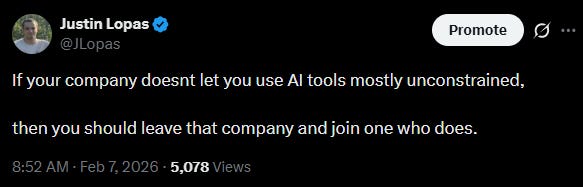
Ultimately, my message to folks in the workforce today is as follows:
How companies should react
The K-shape doesn’t just exist between companies. It exists within them. An AI-enabled marketing team is now meaningfully more productive than a non-AI-enabled legal or finance team sitting in the same building.
I find that the K-shape exists vertically (between firms) and horizontally (across departments). An AI-enabled marketing team (top of the K) is now 5x more productive than the non-AI-enabled legal or accounting team (bottom of the K) in the same company. This creates internal friction, budget misallocation, and slows down the overall business, making the internal productivity lag a major management challenge. Enabling it everywhere is critical.
My view is that companies who care about their knowledge workers have a moral obligation to enable them with AI tools such that they can compete in the talent marketplace (going to the top of the K instead of falling to the bottom). There are certainly risks that aren’t fully addressed (data security, privacy, accuracy), and AI doesn’t solve all problems, but I think it’s important for companies to put effort in here. Even in the most heavily regulated and safety critical companies, there is meaningful acceleration to be had enabling AI for certain workflows.
I'm curious as to how specifically hardware focused employees are using AI to help fuel their workflows? I feel there is a distinction to how a software engineer uses AI compared to a mechanical engineer.
Interesting point on department drift with regards to AI use & productivity. Already seeing many lopsided companies in this regard